
Why Your Business Needs Enemy-Centric Marketing


What feelings do you have when you come across the word “enemy”? Depending on the context, you may feel fear, anger, distrust or defensiveness. Nevertheless, you won’t be indifferent. In a crowded space, as it could be marketing against your competitors, standing out isn’t just about being liked; it’s about standing for something. That’s where enemy-centric marketing comes in.
Rather than playing nice, this strategy connects with your audience by clearly defining what your brand is against. Whether it’s outdated traditions, faulty tech, or poor customer service, identifying a common “enemy” helps customers feel part of a movement when they buy from you, not just part of a company’s revenue. This time, we’ll break down how enemy-centric marketing works, why it resonates so deeply, and how to use it without making your audience angry.
What’s Enemy-Centric Marketing?
Also known as oppositional or antagonistic branding, enemy-centric marketing is a strategy in which a brand defines itself in opposition to an “enemy” or “adversary”, something to defeat for the sake of its audience. This enemy, as I mentioned above, can be anything the brand opposes with its existence and offering: It can be a mindset, a behaviour, an outdated industry or societal norm, injustice, or a competitor that the brand wants to be perceived as the better alternative.
This tactic is as old as propaganda, and this practice has existed even before the term “propaganda” was coined during World War I, with the first ever exhibits of propagandistic activity found in the Athenian civilization in ancient Greece through religious festivals, oratory, games, theatre and their governing body. Since then, propaganda tactics have evolved and influenced other areas of human activity, including, of course, marketing.
Why Enemy-Centric Marketing Works
While enemy-centric marketing doesn’t have an exact date of origin, it has been used since the late 1960s in modern marketing, when Al Ries and Jack Trout developed the positioning theory, which included defining your brand by contrast, often against a market leader, to win the battle for the consumers’ minds. Here’s what defining an opponent for your brand can do when used correctly:
Makes Your Brand Values More Impactful: Instead of vague mission statements or feel-good slogans that may be positive, but that may also fall flat, by stating what the brand is against, enemy-centric marketing makes it crystal clear what the brand stands for.
Boosts Differentiation: Most businesses get lost in the crowd because they’re in a market where several other companies offer the same. Openly fighting against something that your customers want “defeated” helps you stand out by creating a clear contrast; not just in features or price, but in beliefs, values, and purpose.
The “Us vs. Them” Dynamic Connects You With Your Audience: Enemy-centric marketing can create a strong sense of belonging through a clear divide: us (the brand and its community) vs. them (the enemy). This dynamic taps into a fundamental human need: To be part of a group that shares our values, frustrations, or worldview. When you give your audience something to rally around, it can turn them into more than customers: Brand advocates. They wouldn’t be just buying a product—they’re buying into a movement.
Builds Emotional Loyalty: That sense of belonging builds an emotional bond between the brand and its audience. If a brand takes a stand against something its customers also reject—whether it’s injustice, bad service, industry complacency, or detrimental norms, it sends a powerful message: “We see what frustrates you, and you’re right. We’re with you.”
If people feel that a brand understands their values, pain points and aspirations, they start to trust it not just as a mere product provider, but more as an ally that helps them in their struggle, whatever it may be.
Successful Cases of Brands With An Enemy
1 – Dove vs. Toxic Beauty Standards
If you’re a woman, then you know firsthand that beauty standards for us are unrealistic, and we live in constant pressure from society and the media to fit a specific mold to be perceived as attractive or even valuable. Understanding this as a main pain-point for its audience after conducting a global study about beauty and self-esteem, in which only 2% of women perceived themselves as beautiful, Dove stood up to fight against face-tuned perfection and strict definitions of beauty with its “Real Beauty” campaign in 2004, featuring women of all sizes, shapes, ethnicities and ages, and not professional models.

Dove’s Real Beauty campaign for 2014 (Source)
With the slogan “Real Women, Real Beauty,” the campaign directly opposed the beauty industry’s practices by challenging the beauty standards the industry wants to impose to sell their products, with the purpose of redefining beauty as something inclusive, raw and authentic.
The Real Beauty campaign became one of the most famous examples of the use of the idea of an enemy for marketing and is Dove’s most iconic and long-running campaign, inspiring other campaigns around the same theme, such as the 2019 “#ShowUs” campaign that featured a stock photo library of diverse women and non-binary individuals, standing against media representation norms; and the 2021 “Reverse Selfie” campaign, which shows how teenage girls edit selfies to meet the beauty standards and the impact social media distortion of reality has on their self-esteem.
Dove connected deeply with their customers by opposing the harmful norms of its industry, where many brands idealize and perpetuate a “perfected ideal” of beauty: flawless skin, thin bodies and youthfulness. Dove deliberately chose to disrupt the industry narrative by featuring women in unedited photos showcasing their wrinkles, curves, freckles, and stretch marks, conveying the message that it’s okay to have flaws because it’s human and it makes us unique and beautiful.
2 – Apple vs. Boredom and Conformity (a.k.a Microsoft)
I’ve used Apple as a good example in previous blogs because I have to acknowledge that they do a lot of things right, and using an enemy in their marketing is no exception. On this occasion, Apple wanted to say more than their computers were better; they wanted to portray a lifestyle in which unconformity, free expression and creativity rebelled against boredom and dullness, represented by Microsoft’s PCs. Having this in mind, they launched the first Mac vs. PC ad in 2006 with the title “Get a Mac”.
The ads were a series of humourous shorts featuring actors Justin Long, representing the Mac as cool and casual, and John Hodgman playing as “stiff, corporate and boring” PC. The campaign was successful in not only setting a clear “us vs. them” dynamic by reinforcing Apple’s identity as innovative, user-friendly, and rebellious, but it also made tech use a statement of personal identity by giving the Mac and PC human personas that persists until today, more than 15 years since the last ad aired in 2010.
Quick question: Are you Mac or PC? I’m a basic, boring and uncool PC stan. Sorry.
3 – Oatly vs. The Dairy Industry
Swedish oat drink brand Oatly is known for its bold, irreverent and confrontational marketing, and it has openly positioned itself against the traditional dairy industry, challenging the health claims of cow’s milk, its environmental impact and animal mistreatment. Instead of being subtle, Oatly is known for calling out the dairy industry and its lobby loud and proud with slogans like “It’s like milk, but made for humans” and copywriting that talks directly to the reader with a mix of wit and frankness, treating its audience as like-minded equals fighting for the same cause, not customers.
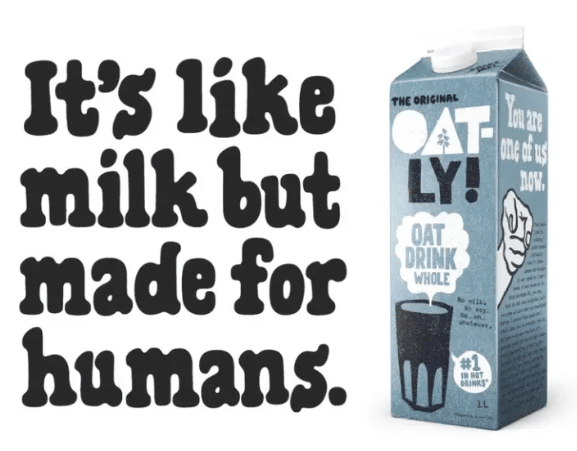
Oatly’s branding and marketing openly question the dairy industry, call out hypocrisy, and it’s refreshingly weird and funny. (Source)
Oatly’s crusade has earned the company a series of threats and lawsuits from dairy boards, like the Spanish dairy board’s lawsuit filed in 2020, alleging that Oatly’s marketing, especially its slogan, was misleading customers into thinking oat drink was cow’s milk and was defaming regular milk. What did Oatly do with that, you ask? Well, besides talking to their lawyers, they used their legal issues to launch the “F*ck Oatly” campaign.

The campaign used the legal allegations against Oatly to create resources for the public to learn more about the company, using their usual witty tone. They also made the F*ck Oatly website to document their legal battles. Here’s a paragraph regarding their lawsuit in Spain that’s too good not to share:
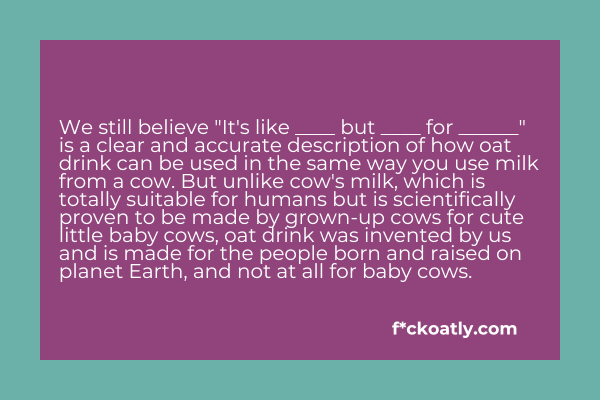
You can read the rest here and more about Oatly’s haters if you’re in for a good laugh.
Oatly doesn’t just sell oat milk; it sells an attitude and resonates with vegans, plant-based consumers, eco-conscious people seeking brands aligned with their values, and those concerned for their health, skeptical of dairy marketing and the food industry narratives. It also built a community around activism, sustainable living, and irreverent humour. By doing so, Oatly created a sense of belonging not just among plant-based drink fans, but among people who want their values represented in the brands they consume.
Do You Know Your Enemy?
Creating an enemy for your brand is not about being negative; it’s about standing against something that your audience also rejects, in order to unite and inspire them. If you want to dive into enemy-centric marketing, here’s what you need to ask to yourself:
Why does your brand exist? Knowing the purpose of your brand is essential to defining a believable enemy, because said enemy is often the obstacle to your brand’s mission. If you know what change you want to see in your industry or the world, and know how your offering can help your customers, who have the same purpose as you, you should be able to craft your brand’s enemy.
Understanding Your Audience’s Pain Points and Values: Knowing what bothers and concerns your audience, as well as what they stand for, will help you create an enemy that reflects their shared frustrations regarding your industry.
Make Sure the Enemy Aligns With What You Offer: Your brand enemy should be its antithesis to contrast with your offering and strengthen your identity naturally. For example, if your brand stands for simplicity, it should rally against complexity and bureaucracy.
Once you have an idea of what your enemy could be, see if it follows these criteria:
The enemy’s idea doesn’t alienate or offend your audience;
Doesn’t target a competitor in a derogatory way, but calls out what they represent, like Apple and Oatly did;
Supports your brand’s storytelling, and;
It’s not just a tool for criticism and pettiness.
Dare To Be Combative In Marketing
There are thousands of brands in every industry worldwide, so it’s safe to say that it’s a cutthroat game out there. Instead of being cautious with your marketing and only saying that your products are the better alternative just because, remember that you created your business with more purpose than income in mind, use it in your favour and take a clear stand in what you’re fighting for. Define an idea, system, or mindset your audience rejects and tell them why you’re different.