
Inside K-pop Demon Hunters’ Unexpected Success

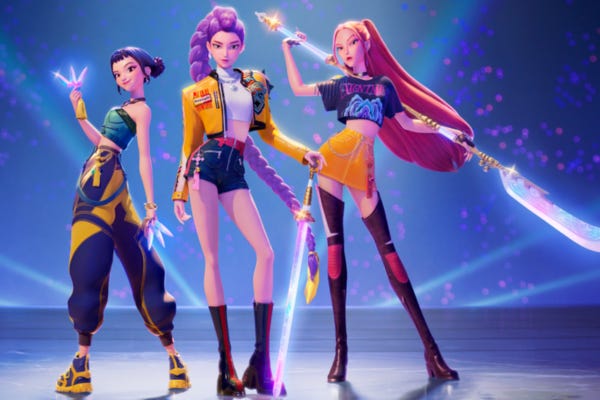
Even if you’ve been living under a rock, I’m sure you’ve heard about Sony Pictures Animation’s K-pop Demon Hunters. When I watched the day of its release on Netflix (its global distributor and the owners of most of the film’s rights), influenced by one of my favourite girl groups Twice’s feature, I wouldn’t have imagined in a million years the astounding success it was going to become. This viral pop culture phenomenon was unexpected for many, including Netflix and Sony, and both have had to pivot to respond to the sudden demand for more content from the film, the best they could. We’re going to recount the marketing and movie-related products offering measures Netflix has applied (and should apply) while we discuss what we can learn from this case of unanticipated demand.
Good Measures Netflix Took to Respond to K-pop Demon Hunters’ Success
1 – Creating More Ways for Fans to Engage
Two months after the original release date on Netflix, the film gained a sing-along version with a limited two-day release event in movie theatres on August 23 in selected regions like the US and South Korea, and a worldwide streaming release. The theatrical release sold out in several regions and dominated the box office in the US, taking around $19.2 million.
So, why were people more than willing to pay for a movie they’ve already watched at home? In this economy? We can say it was due to the scarcity and event effect that made people obsessed with the movie and the soundtrack feel the need to go and watch the film on the big screen and sing the songs with other fans, making feel the release like something special because a movie meant never to leave the streaming sphere got so big that it had to hit the big screen. People wouldn’t want to miss it.
Also, it wasn’t the exact same movie. The sing-along element made paying for the theatre ticket worth it due to the fact that it promised a different experience from a standard, quiet screening. Lastly, this phenomenon has formed a fandom that wants to interact with each other, and the streaming format is more isolating for most of them; the theatrical release was the first opportunity the fans had to get together in a tangible way.
2 – Social and Fandom Activation
As soon as Netflix saw the hype the movie had, they actively amplified and curated fan participation to keep the momentum alive beyond its release window. Here’s how:
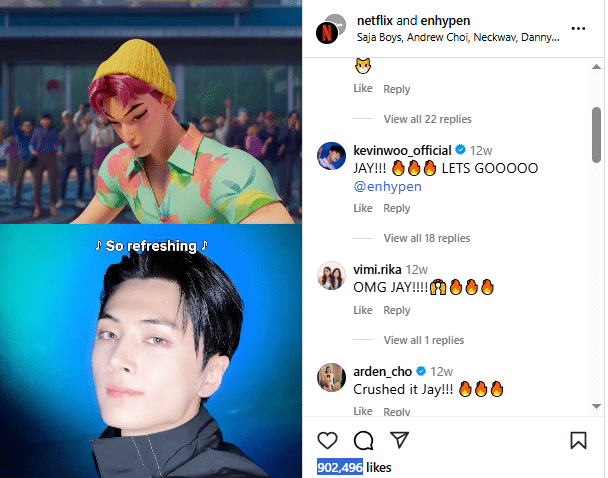
Amplifying Organic Content: Netflix actively engaged in K-pop culture behaviours like sharing idols’ dance challenges, leveraging the artist’s fandom. One example of this is an Instagram reel of Enhypen’s Jay dancing “Soda Pop” choreography. The reel now has 902.496 likes and approximately $1.2 million in earned media value (the metric that gives monetary value to the free publicity a brand gets from organic mentions).
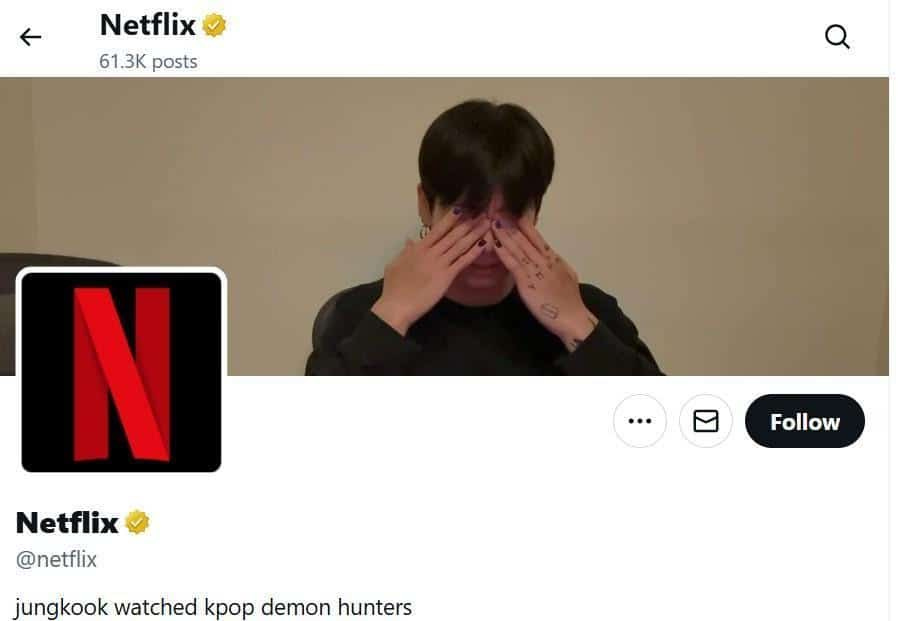
Another time a popular idol shared content about the movie was when the (very popular) Jungkook, from the even more popular group BTS, mentioned during a livestream that he watched the film and was touched by it. This casual comment made Netflix update its X bio and banner to reflect it, sparking more viral buzz.
Lastly, the wave of female idols’ covers for “Golden” also helped to promote the film for free. Here’s one if you want to give it a listen:
Netflix used this boost from the K-pop world to leverage stan culture’s natural behaviours and make itself part of the fan ecosystem. This was a calculated move to attach the new franchise to the (very engaged) K-pop fandom, which will help the streamer get a big (and free) boost to the promotions for the upcoming K-pop Demon Hunters media. This fandom activation also helped to create a strong community for the franchise.
Things to Improve
One thing about unexpected demand is that even a big company like Netflix can struggle to meet clients’ expectations. These are the areas in which they can do better for the beloved idols and demon hunters:
The Merchandise
It’s evident that Netflix wasn’t expecting the big waves this movie ended up doing, because the official merch’s current offering is quite underwhelming:
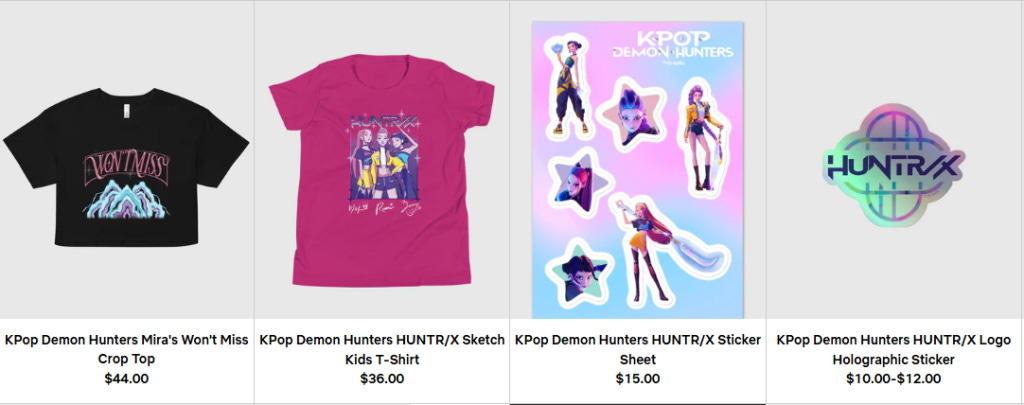
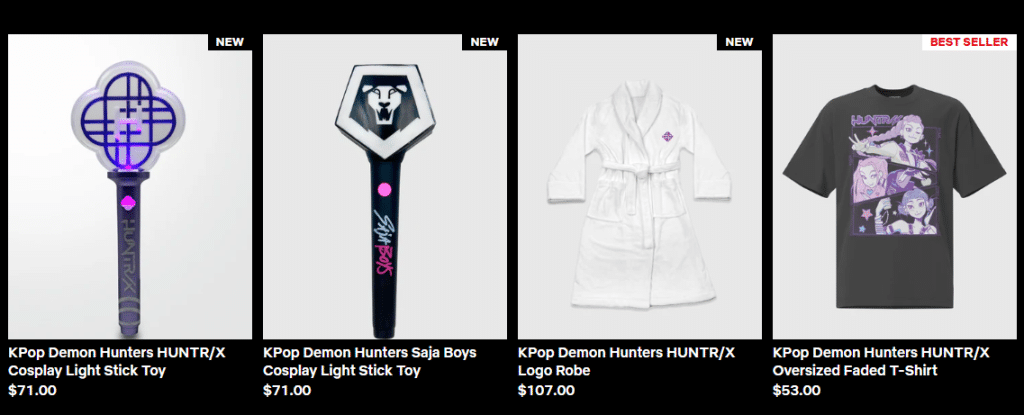
First of all, the prices are insane ($15 for a sticker sheet? And up to $12 for one sticker? No thanks. Aliexpress here I go.) Second, the new addition of the lightsticks for cosplayers is cute and all, but still way overpriced: Just for your reference, Twice’s lightstick (a real-life group, mind you) costs $48.03 in the official store. (A little idol lore explanation: Originally from the Japanese idol scene, lightsticks are used by fans to show support for their favourite artists and create synchronized, colourful light displays in the audience. Lightsticks often have unique designs and light colours customized for each artist or group, and are considered a symbol of each fandom).
Lastly, the clothing and other items’ designs are nothing special enough to justify the price tag.
One good idea to improve the merch would be including fashion dolls, and some fans that are also doll customizers have started to create their own versions of Rumi, Mira and Zoey:
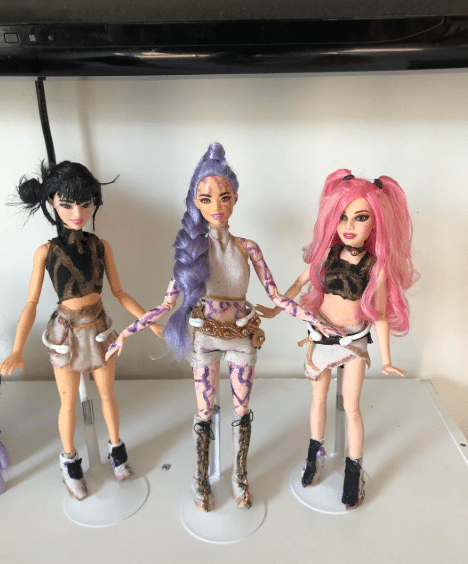
The customizer stated that these are prototypes. (Source)
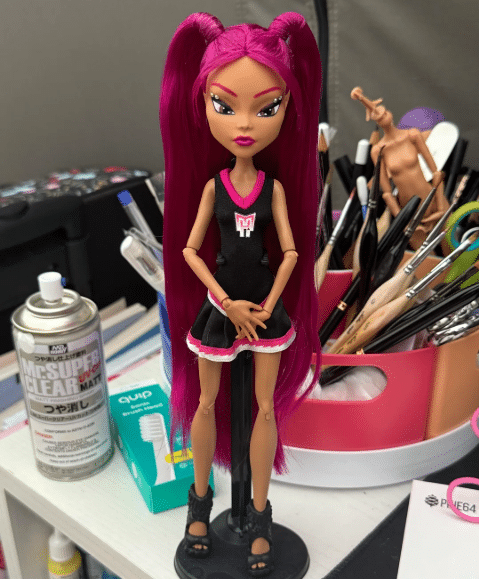
A custom Mira mixing the movie and Monster High’s style. (Source)
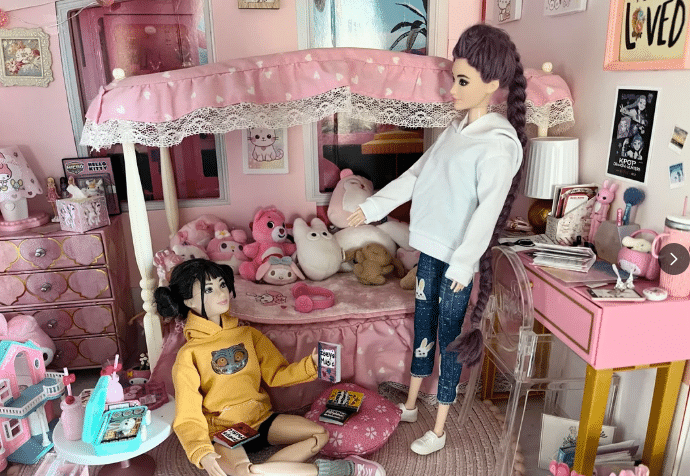
Even some entrepreneurs are selling dolls, figures, plushies, funkos and other unofficial items like backpacks:
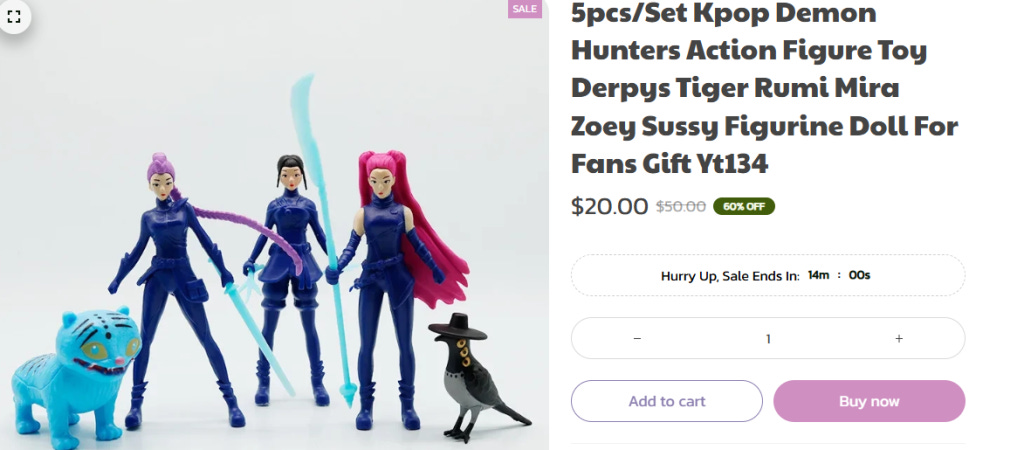
Is this a future lawsuit? Maybe, but they offer more options for better prices. (I don’t know if hip hop and gothic are meant to mix, though, but I digress.) Source
I’m sure that Netflix won’t leave money on the table and is monitoring what people say they want to see from the franchise, so they’re surely working on offering more for the money they’re charging.
Update: While I was writing this article, Netflix and Mattel announced a collaboration to release K-pop Demon Hunters fashion dolls, releasing on November 12. I’ll update as soon as they’re available to assess if they’re a hit or miss.
What Netflix’s Next Steps Could Be
Focus On Building IP Long-Term Value
What we’ve seen so far is Netflix reacting to an unexpected success and trying to retain streaming numbers and interest for what’s to come. With a sequel currently in discussion, we’ll close with a few ideas Netflix might use to expand the franchise beyond streaming screens:
Expansion Through Transmedia Storytelling
This would be similar to what Disney has done with the Marvel movie franchise (Kinda. More on why later) because the K-pop slayer queens Netflix has in their hands are an excellent fit for it. Think about sing-along videogames for console and mobile, spin-offs, comics, webtoons, graphic novels or animated short films and series. Extending a narrative through different media formats is a concept popularized by media scholar Henry Jenkins in 2003, who described it as the inevitable path media companies would follow for “the construction and enhancement of entertainment franchises”.
Transmedia storytelling is meant to satisfy fans’ demand by providing new experiences and insights into the characters and their world, and every piece of media serves as one piece of the puzzle of the fictional world’s lore. Companies that execute this well will gain a more invested audience and a strong fandom that makes its own contribution to keep the franchise alive via theories, fanfiction and fanart (a.k.a free advertising).
However, companies can’t just produce content like there’s no tomorrow. Above, I said that the Marvel franchise is kind of an attempt at transmedia storytelling, mainly using the movie and TV show formats to target the non-comic geek fans and the general public. Unfortunately, it went wrong the moment they started to air the series on Disney+, because in order to watch most of them (if not all) people had not only to watch at least some of the previous movies (which is normal people did if they’re fans) but now they also had to watch those TV shows to enjoy the subsequent phases of the cinematic aspect of the franchise and being able to get a full grasp of the plot. Lastly, some of the shows were meaningless to the storytelling and frankly a waste of time (I’m looking at you, Moonknight), and none of them served as an entry-level content for new fans to get to know the rest of the franchise. This resulted in a mash-up of convoluted storylines and many discouraged committed fans along the way.
My Marvel rant’s goal is to say that if Netflix takes the transmedia path to build a sustainable IP, it needs to:
Keep it cohesive: In the best-case scenario, the creative team and writers behind the original film should be behind the conceptualization of content for other media. A good example of this is the Matrix franchise, in which its creators, the Wachowski sisters, have had full control, lore supervision or guidance roles over the expansion of the story through animation, video games and comics.
Don’t Pull a Marvel: That is, in Jenkins’ words, making sure the main franchise and its expansion products are self-contained enough to enable autonomous consumption. Simply put, if the next product they launch is a K-pop Demon Hunters video game, the audience should be able to enjoy it without having to watch the film and vice versa. This consumption autonomy allows all content (or most of it) to work as an entry point to the franchise as a whole, regardless of a lack of previous knowledge.
Another cautionary tale from the Marvel case, Netflix should learn from is to pace the timing of product releases. Marvel kicked off its TV series expansion with WandaVision in 2021, then they got a little too excited and released ten movies, twelve TV seasons and two TV specials up until 2024, sacrificing quality over quantity in the process. This hectic schedule caused fatigue within the audience, especially the most casual ones. So Netflix, if you don’t want us to get tired of K-pop, keep the quality high and the releases on a schedule people with lives can keep up with.
Focus on long-term world planning: Taking the one-time viral success and using it as a foundation for a narrative universe requires direction, consistency and content cadence. This is what Marvel did for the Infinity Saga, which was planned years in advance, allowing interconnected stories to converge meaningfully in Avengers: Endgame while giving creators room to tell smaller, character-driven stories over the years of rollout.
Long-term planning also means thinking about when the original creators are not around anymore. A franchise survives decades only if new creative voices can reinterpret or expand it. Leaving intentional narrative “gaps” or open threads allows evolution and the adaptation of the universe to cater to new audiences while maintaining continuity. Star Wars has thrived for decades because its universe has left unexplored centuries, cultures, and perspectives over the years, enabling creators to branch out from the original Skywalker-focused storyline and create series like The Mandalorian or Andor, while staying true to the core story.
Foster fandom participation: Lastly, a franchise (or any brand) is nothing without loyal fans. In transmedia storytelling, fans are not a passive audience: it’s an active and creative force that extends the life and cultural impact of a franchise. Encouraging and acknowledging fandom activity turns the fans into unpaid marketers and a source of inspiration for future releases, whether it’s new content or mech, that keeps the franchise alive in the cultural conversation. So far, Netflix has shown signs that they’re going to foster fandom culture around this movie, as we discussed earlier, and they’ve done so with Stranger Things; that’s why I expect to see the development and strengthening of the K-pop Demon Hunters’ fandom.
Food for Thought: In Case of Unexpected Demand
I want to end this sort of “dissertation” by reflecting on what you can take with you as doable strategies in case your business experiences its own sudden, unexpected demand:
Act as quickly as possible: Acting swiftly to capitalize on momentum rather than adhering rigidly to initial launch plans is essential to take advantage of your clients’ attention. Even if you’re a small business with limited resources and a small manufacturing capacity, acknowledging and appreciating the success of your product, and asking for your clients’ patience while you adjust to meet the demand, is enough to keep people staying tuned.
Get familiar with adaptive marketing: In the era of social media, where audience sentiment can change in less than a second, being strict with fixed-term campaigns is a guaranteed way to lose clients and be perceived as out of touch. Adaptive marketing is a relatively new approach that’s gaining traction thanks to data analytics and, especially, AI. The rise of real-time data tools for marketing allows businesses to shift their campaigns and strategies as they’re active, delivering a more tailored message and experience.
Adaptive marketing means that you should join the conversation, not control it. That’s what Netflix did when they leaned into the viral dance covers and meme culture. A small business seeing a sudden product spike on TikTok, for example, should hop on and ride that wave too: repost reviews, engage with commenters, and temporarily prioritize social responsiveness over scheduled campaigns.
Leverage crossovers: Netflix probably expected that the movie would be watched only by kids, K-pop fans and maybe animation lovers willing to ignore the cringey name. However, it reached the general public. Unexpected popularity often means your product connected with an audience you didn’t plan for. Instead of forcing it back into your original demographic, embrace the crossover and adapt to them. For example, if you own a skincare brand with a product targeted towards women 40+, but it became popular among Gen Z due to reviews, don’t ignore it and start collaborating with creators in that demographic.
Strengthen Your Infrastructure for Scalability: The minor mishaps we’ve seen after the movie’s success happened because Netflix obviously wasn’t prepared for the international attention the film received. Hence, the poor merch the limited few follow-up activations like the theatrical sing-along version release.
These operational weaknesses are exposed whenever a viral surge like this one happens. Instead of getting caught by surprise and being reactive, anticipate the “what if this blows up?” scenarios in your planning stage, even for seemingly mid-tier products. Also, make your business as scalable as possible for key areas like production, fulfilment, stock and customer engagement.
A Case Study on Navigating the Unexpected
There you have it. K-pop Demon Hunters wasn’t just your average Friday Netflix movie; it turned into a global phenomenon and is now a case study in how to deal with a success powered by community that turned a seemingly mid-tier movie into the top animated film of the year. If K-pop Demon Hunters proved anything, it’s that when creativity meets cultural resonance (and a company is fast enough to join the conversation and fuel it), surprise hits can become the foundation of an entire entertainment franchise or business line.